
Where does your data live?
Location and the party that runs the infrastructure: which country, which provider, which regions. Data residency is a good start, and not the whole answer.
Sovereignty is not a switch. It is a spectrum you move along, one deliberate step at a time.
A calm guide for organisations that want more control over their collaboration tools and AI, without throwing away what already works. Four questions, four steps, and the questions to put to any supplier.

Digital sovereignty means that an organisation itself decides where its data lives, which law can reach it, which AI models work with it, and how it can leave a supplier again. It is about control and choice, not about distrust of any one product: the location of a data centre matters, and so does everything around it.
Ask them of every tool you use, from a chat app to an AI assistant. The answers show where you stand today and where a next step would help.

Location and the party that runs the infrastructure: which country, which provider, which regions. Data residency is a good start, and not the whole answer.
Jurisdiction: under which legal systems does the supplier fall, and could a foreign authority ask for access? That can hold whatever the location of the data centre.
Who processes your prompts and documents, where the model runs, and whether you can choose or switch the model.
Portability and exit: can you export your data in a usable form, and could you change supplier without your team grinding to a halt?
None of these has one right answer. What matters is that you make the choice knowingly.
Working together is more than storing files. Pick a C to see the sovereignty question behind it, why it matters and what to check with any supplier.
Everything an organisation knows ends up in documents, sheets and boards. When they sit in a closed format with one supplier, every change of tool means rework and leaving gets expensive. Ownership you cannot exercise is not control.
In CoVince: documents, grids and slides are made in our own editors, in the journey where the team works.
Read more: Exit strategy from big tech: a step-by-step plan →People and their access are the real perimeter. Loose guest accounts, shared logins and unclear roles leak more than any data centre. Identity data and behaviour patterns are valuable to whoever holds them.
In CoVince: who sees and may change a board or document is set per organisation and journey, in one place.
Read more: Schrems II and the GDPR: transferring data to the US →Actions, approvals and workflows become the operating rhythm of the organisation. Built inside one vendor’s logic, they cannot move with you, and afterwards you cannot show who decided what.
In CoVince: a canvas with a timeline and an action list with owners and dates sit in the same journey as the chat.
Read more: All-in-one platform or separate tools: what to choose? →Knowledge is built in chats, documents, reviews and training. When it trains other parties’ models, or is locked in a tool you cannot leave, your expertise slowly becomes someone else’s product.
In CoVince: a journey keeps chat, people, files and the timeline together, with access set per organisation and journey.
Read more: Procurement checklist for sovereign software: 15 questions →Chat and video carry decisions before they reach a document. The content is only half of it: who spoke to whom, when and for how long can reveal as much, and a foreign authority may ask for it whatever the location of the data centre.
In CoVince: chat and video calls start from the journey, and the platform runs on European infrastructure.
Read more: The CLOUD Act explained: what it means for your data →An AI colleague reads your prompts and documents. Who runs the model, where, and whether you can swap it decides where that content goes. The AI Act adds to it: you should know which model runs for what, and AI-generated media needs transparency.
In CoVince: an organisation admin chooses the model per level, including European models from Mistral AI and Scaleway or local models; AI-generated audio and video get a machine-readable marking in the metadata.
Read more: European AI models for your organisation: Mistral and more →Most organisations do not move everything at once, and they do not need to. A hybrid set-up, where some tools stay and sensitive work moves, is a perfectly valid place to be.

You know which tools hold which data and under which law each supplier falls. A simple inventory is enough to begin.
Work that needs the most protection, such as HR, health, board or client files, runs on infrastructure and under a legal framework you chose. The rest can stay where it is. For many organisations this hybrid stage is a good place to stay.
You decide which AI model touches which data, per level and per team, and you can switch when needed.
Your data can leave in a usable form and you have thought through how. Staying with a supplier is then a choice, not a dependency.
Products such as Microsoft 365, Google Workspace, Slack, Miro and Notion are strong, and many organisations keep using them. Sovereignty is about the choices you make around them.
Five developments, stated factually. Each has a full article under further reading.
Since 2018 the US CLOUD Act lets US authorities request data from US companies that they control, also when it is stored in a European data centre. It is one reason jurisdiction is a question next to location.
The CLOUD Act explainedIn 2020 the European Court of Justice struck down the Privacy Shield. Since then, transferring personal data to the US remains a case-by-case assessment.
Schrems II and the GDPRThe NIS2 directive asks organisations to manage the security of their supply chain. Your collaboration tools are part of that chain.
NIS2 and your toolsThe European AI Act contains transparency rules (article 50) for AI-generated content, and expects you to know which model runs for what.
AI Act, article 50The more of your work sits with one supplier, the harder it is to move. The European Data Act gives switching between cloud services a legal basis.
Your exit strategyThey apply to a European provider as much as to a global one. A good supplier can answer them plainly.

Where is our data stored and processed, and by which sub-processors?Ask for regions, providers and the full list.
Under which legal systems do you and your infrastructure fall?Including parent companies and subcontractors.
Which AI models process our content, and can we choose or switch them?Per team or per level, with a fallback.
What do we get when we leave?Formats, timeline and costs of an export.
How are access and roles set?Per team, per project, in one place or in many.
What is certified, and what is still in preparation?A plain answer beats a long list of badges.
One example of these principles at work, shown with real CoVince screens and demo data (Meridiaan B.V.). It is one possible route, not the only one.
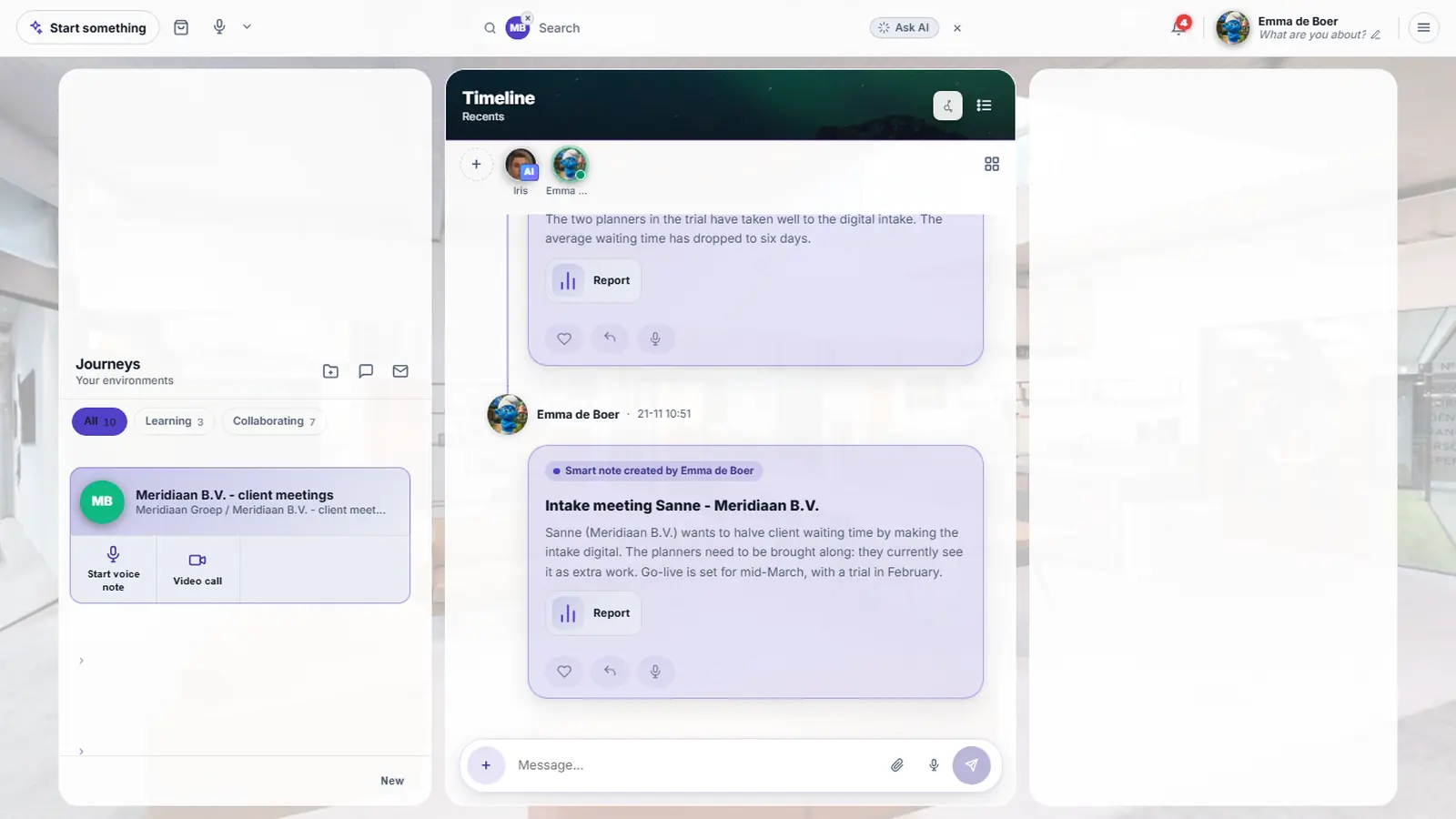
A journey is the place for a project or team, with chat, people, files and a timeline. Who sees what is set per organisation and journey.
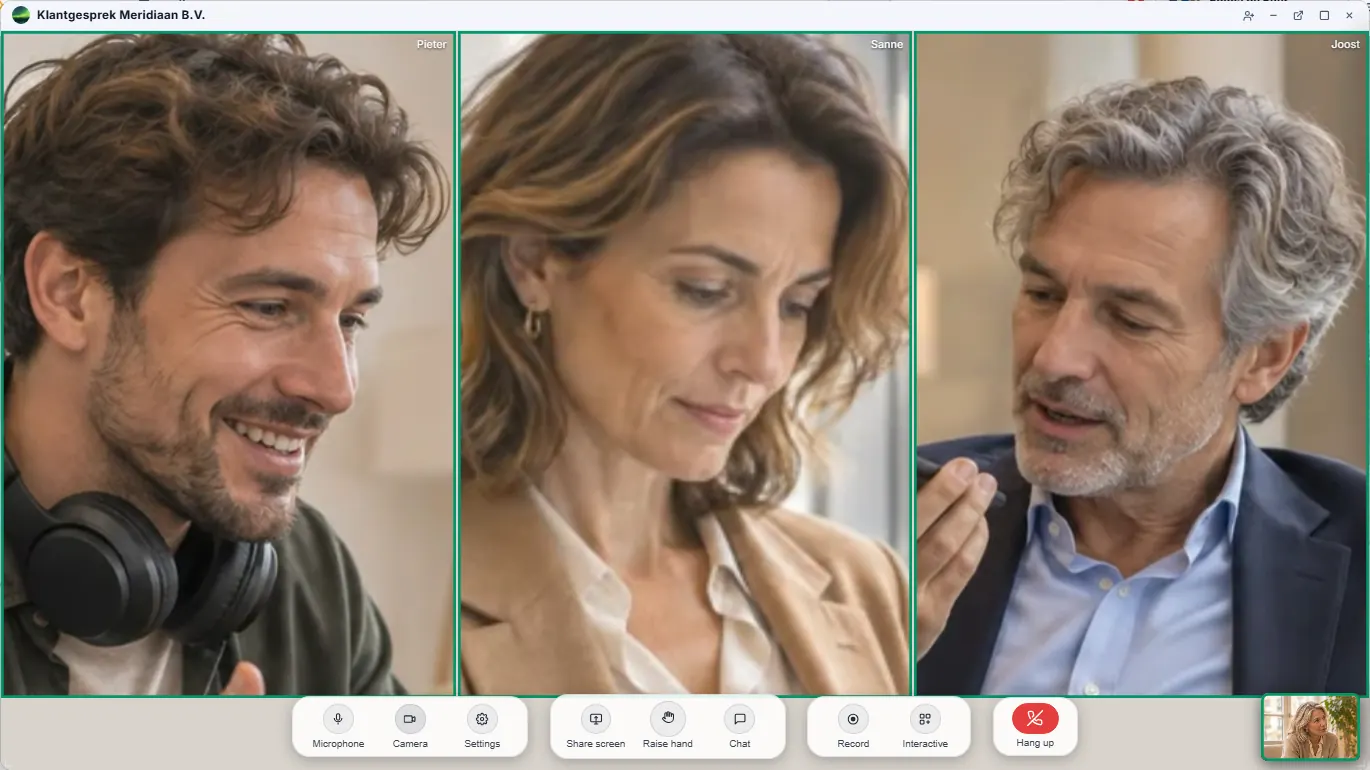
Call from the journey and see the same live wall, with remote colleagues on screen.
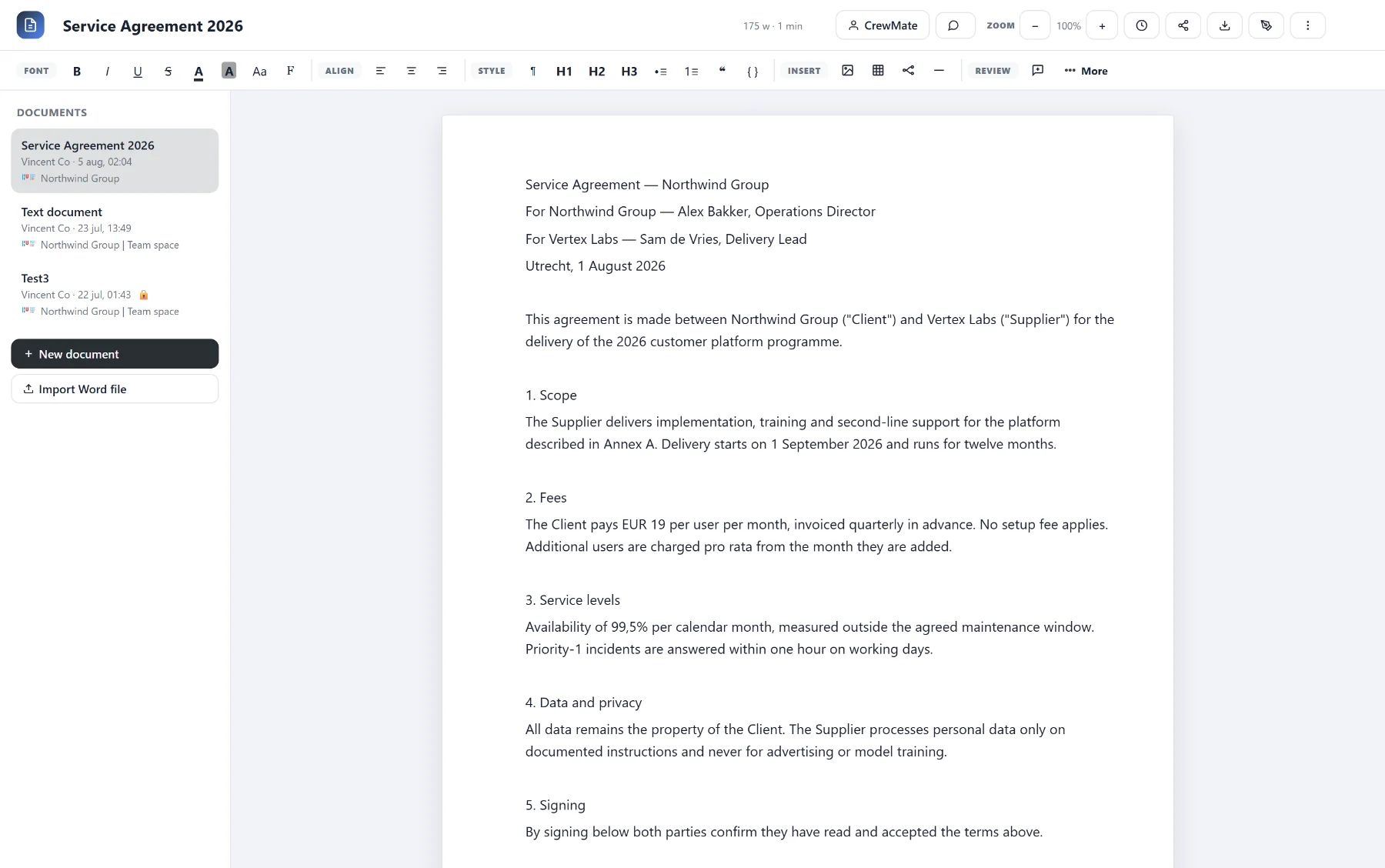
Own editors for documents, spreadsheets (grids) and presentations that the team works in together.
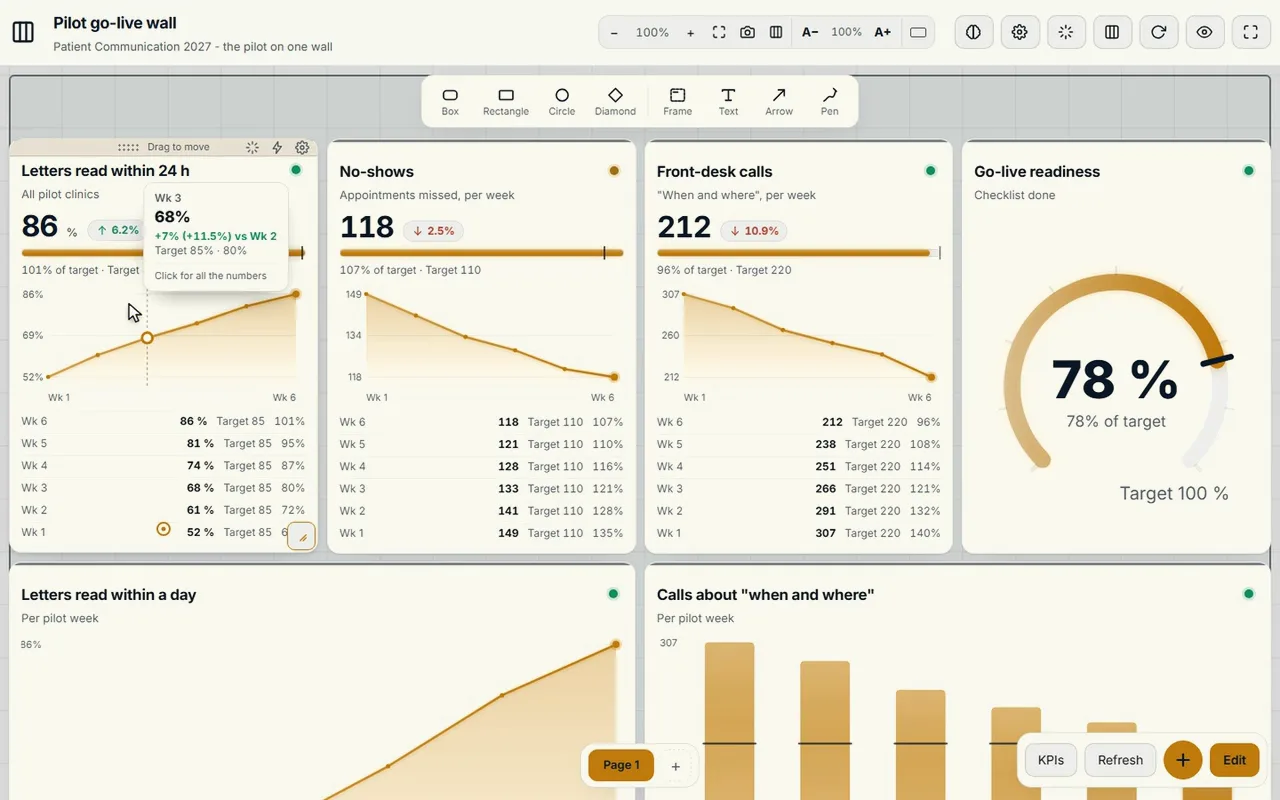
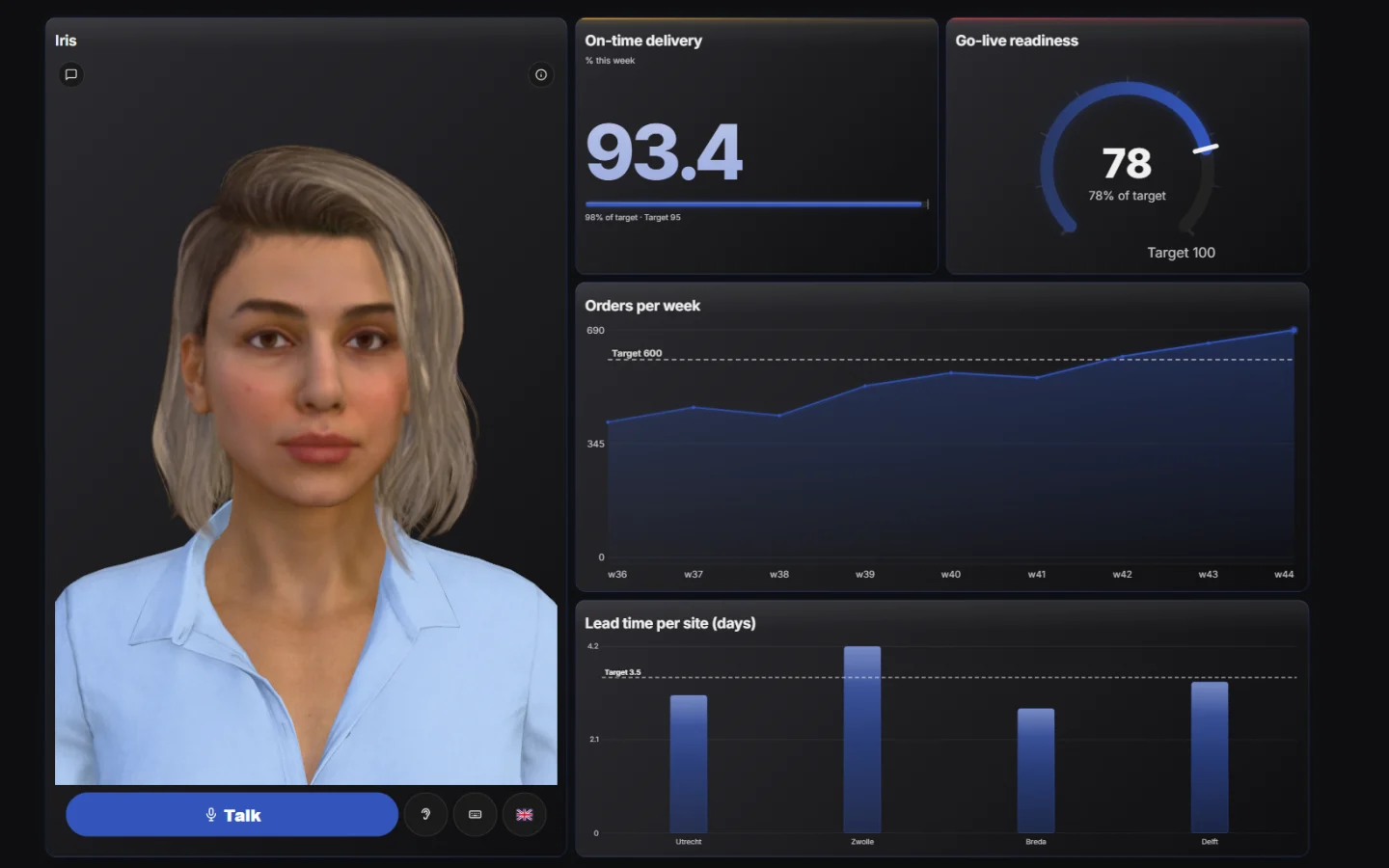
Live walls with KPIs, trends and actions. See also the page about the digital Obeya.
To the digital Obeya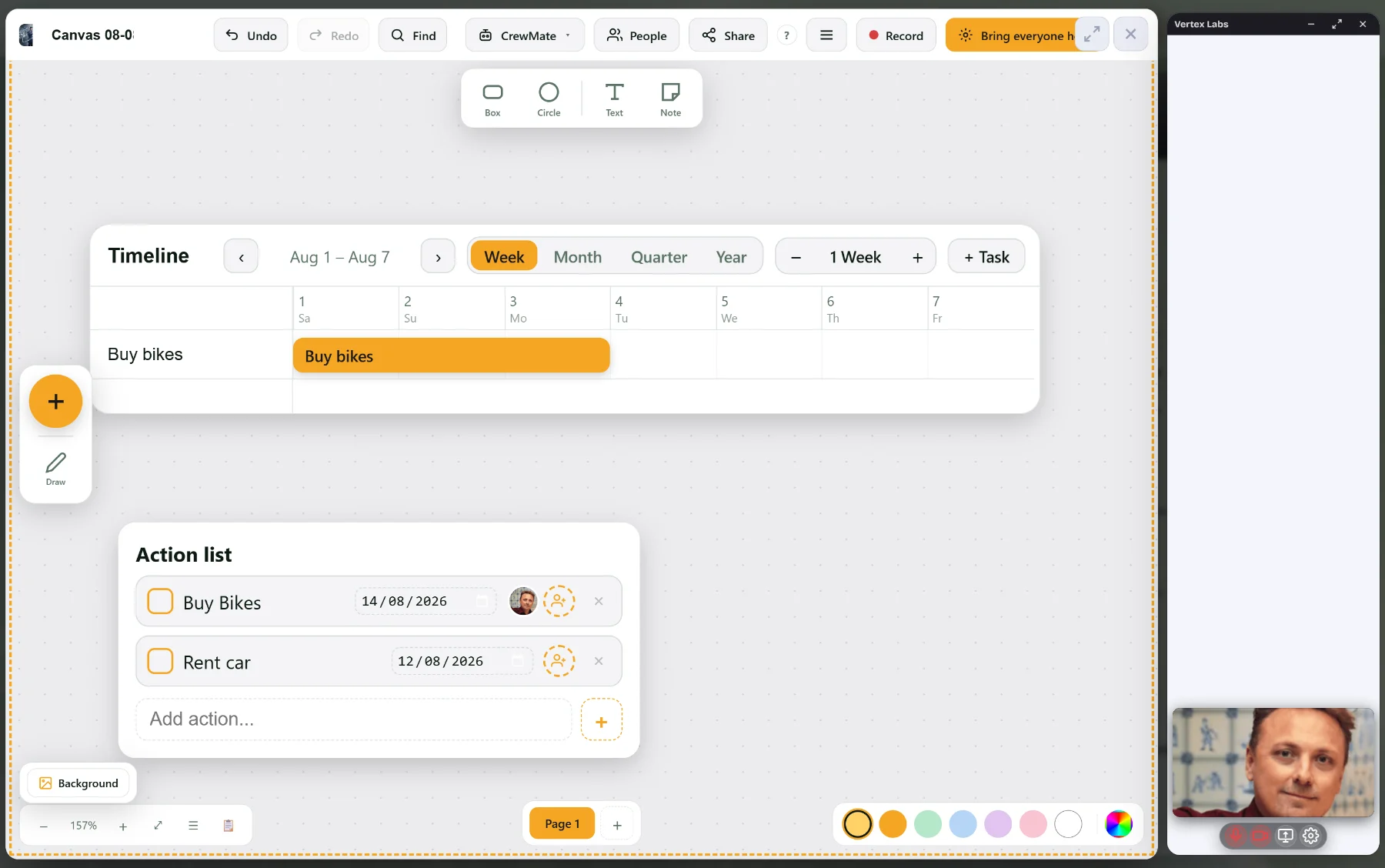
A board with a timeline and an action list with owners and dates.
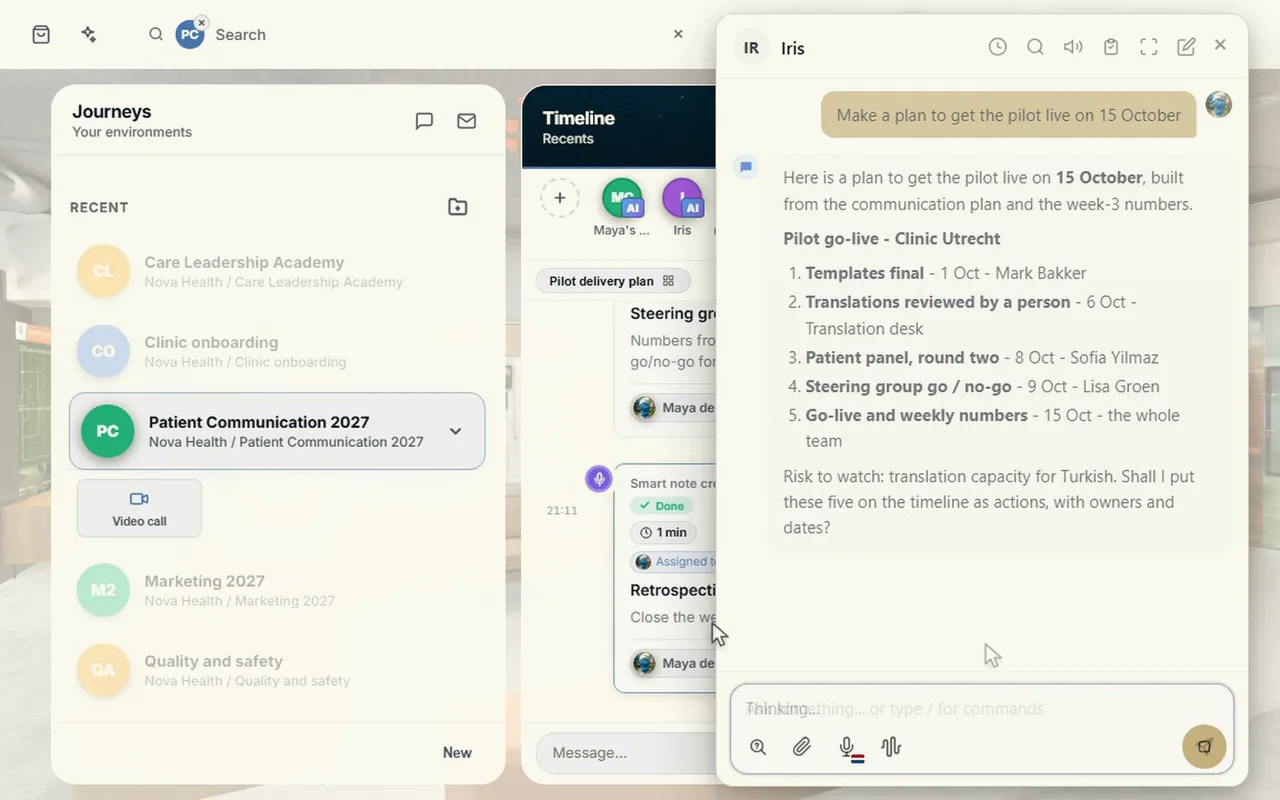
An AI colleague that thinks along, makes a plan and fills the board. You choose which model runs behind it.
To the CrewMate pageCoVince runs in Europe, a European cloud provider. AI models are decided in one place, in levels (top, standard, fast), and an organisation admin chooses a model per level.
Models from Mistral AI (EU endpoint) and from Scaleway (Europe) can be chosen in the model picker, for chat and for speech to text.
If an EU model is unavailable or gives no answer, CoVince falls back to the next model instead of showing an empty screen.
CrewMate can also work with a model that runs on your own machine. Then the question does not leave your device.
AI-generated audio and video gets a machine-readable AI marking in the file metadata, a basis for article 50 of the AI Act.
An organisation admin chooses per level which model is used. European models are one of the choices; we do not claim that all AI runs in the EU.
Further reading: voice-driven reporting with local or European models, and steering your organisation in a digital Obeya.
A short checklist you can hold any provider against, with the CoVince answer next to it.
| What to look for | Why it matters | How CoVince answers |
|---|---|---|
| Supplier and jurisdiction | It decides which law can reach the data, whatever the location of the data centre. | European software company; the platform runs in Europe. |
| Number of products and contracts | Fewer moving parts are easier to assess, secure and leave. | One platform for journeys, chat, video calls, documents, boards and AI. |
| AI model choice | It decides who processes prompts and documents. | Selectable per organisation, including Mistral AI (EU endpoint), Scaleway (Europe) and local models. |
| Access and permissions | One place to control who sees what limits mistakes. | Per organisation and journey, in one place. |
| AI-generated media | Transparency rules such as article 50 of the AI Act ask for it. | Machine-readable AI marking in the metadata of audio and video. |
Explainers and guides on the CLOUD Act, NIS2, the AI Act and European options. The articles are available in Dutch, English and German.
 SovereigntyWhat is digital sovereignty? A guide for organisationsControl over your data, your AI and your exit: more than the location of a data centre.
 SovereigntyThe CLOUD Act explained: what it means for your dataWhy data in a European data centre is not automatically out of US reach.
 SovereigntySchrems II and the GDPR: transferring data to the USThe Privacy Shield fell in 2020. What that means for tools from US providers.
 SovereigntyNIS2 and your collaboration tools: the supply chainWhy your chat, video and documents are part of your supply chain.
 AIAI Act article 50: transparency explainedWhat the transparency rules for chatbots and AI-generated content ask.
 SovereigntyExit strategy from big tech: a step-by-step planSeven steps to be able to leave a supplier without your team grinding to a halt.
 SovereigntyData Act: switching cloud providerWhat the European Data Act regulates about switching between cloud services.
 SovereigntyData residency is not sovereignty: the differenceWhy data in a European region is not the same as control over it.
 AlternativesA European alternative to Microsoft TeamsChat, video calls, documents and boards in one European platform, compared honestly.
 AlternativesA European alternative to Slack: chat in your journeyChat per project, connected to video calls, documents and boards.
 AlternativesA European alternative to Miro: canvas and boardsA canvas with sticky notes, actions and timeline, connected to the rest of your work.
 AlternativesA European alternative to Notion: documents and gridsDocuments and grids in own editors, with table, kanban and timeline views.
 AlternativesA European alternative to Google WorkspaceDocuments, spreadsheets and presentations in own editors, with chat and video alongside.
 AIA European alternative to Microsoft CopilotAn AI colleague in your boards and documents, with a model you choose yourself.
 AlternativesAll-in-one platform or separate tools: what to choose?When an integrated platform fits, and when separate tools are better.
 AIEuropean AI models for your organisation: Mistral and moreWhy it matters which model processes your data, and how to choose a European model.
 AILocal AI models on your own machineAI that does not leave your own device: when it fits and what the limits are.
 AIMarking AI-generated content in metadataA machine-readable AI marking in the metadata, and what you arrange on top.
 SectorsGDPR-proof collaboration in healthcare: what to arrangeWhat to arrange for chat, documents and AI when health data is involved.
 SectorsGDPR-proof collaboration in educationPupil data, US tools and AI: what a school or institution arranges.
 SectorsDigital sovereignty for municipalities and governmentWhy administrative data, procurement and NIS2 make a European alternative interesting.
 SovereigntyProcurement checklist for sovereign software: 15 questionsFifteen questions for your supplier call or RFI.
No: sovereignty is never finished and we do not claim it is. CoVince runs in Europe, a European cloud provider, and is ISO 27001 certified. On top of that: one platform, access per organisation and journey, selectable European AI models and an AI marking in the metadata.
That you decide where your data lives, which law can reach it, which AI models work with it and how you can leave a supplier. It is about control and choice, not only about the location of a data centre.
Not by itself. Data residency says where data sits; sovereignty is also about which law can reach it. A company under US law can be asked for data under the CLOUD Act, also when it is stored in Europe. That does not make a product bad; it is one of the factors to weigh. See the article on data residency and sovereignty.
Yes. In the CoVince model picker you can choose European models from Mistral AI (EU endpoint) and Scaleway (Europe). An organisation admin switches them on and chooses the model per level.
It combines chat, video calls, documents, spreadsheets, presentations, boards and an AI assistant in one platform. Many organisations keep some tools and move only the sensitive work, which is a fine route. In a demo we walk through what fits for you.
Start with one team and one journey, for example for a project or the weekly stand-up. That shows what fits before you move more. We promise no automatic migration here.
No tool does that for you. Compliance stays the responsibility of your organisation. CoVince can be part of a controlled supply chain and shows you which AI model runs for what.
In half an hour we show the real screens and answer honestly what can and cannot be done.