
Marking AI-generated content
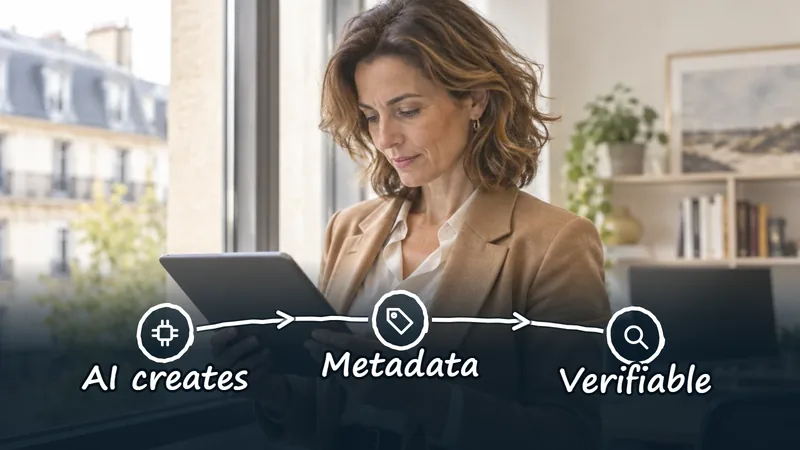
Marking AI-generated content in metadata is the basis for what article 50 of the AI Act asks: that AI-generated content be recognisable in a machine-readable way. In CoVince, AI-generated audio and video therefore get a marking in the file metadata. We do not add a visible label in the picture: how you show AI use to recipients is up to you.
What a metadata marking is
Besides their content, files carry metadata: fields that describe what the file is, when it was made and with which tool. A marking such as "AI-generated" in those fields can be read by software without changing the picture or sound. That lets platforms, archives and checks see automatically that a file was made or edited by AI.
What CoVince does
- AI-generated audio and video get a marking in the metadata at the moment the file is written.
- No watermark, overlay or label appears in the picture or the player.
- Exporting a video itself is free; AI steps cost credits.
What you arrange yourself
A metadata marking is a basis, not a full implementation of the law. As an organisation you must decide whether and how you inform recipients, for example in a caption, a terms page or the accompanying text. That differs per situation. It remains your responsibility, and a platform alone does not make you compliant. See article 50 explained.
Why no label in the picture
A label burned into every video does not work for every use: an internal training, a product demo and a deepfake call for different forms of openness. By putting the marking machine-readably in the file, the picture stays yours, and you can choose how to show it at the place of use.
An example: the training department of a logistics company
Imagine a fictional logistics company that makes instruction videos for drivers. Part of the voice-over is AI-generated, another part is recorded by a colleague. Exporting the video is free, the AI voice costs credits. The file carries the marking in its metadata. The department also agrees: the description of each video has a short sentence that the voice was made by AI, and the internal handbook says who checks that. For an external customer video the department chooses a more visible caption. So the same file carries two layers of openness: machine-readable for systems, and readable for people where it matters.
Checklist for your organisation
- Which tools generate audio, images or video?
- Do they mark the output in a machine-readable way?
- Where and how do you make AI use visible to recipients?
- Who is responsible for that arrangement?
- How do you check that the marking is not lost when files are shared or reused?
Common mistakes
The first mistake is assuming a marking in a file covers the same duty as openness towards people. The second is re-encoding a file or running it through another tool without checking that the metadata survives. The third is not naming an owner: everyone thinks someone else arranges it. Anyone buying a new tool can add the question about marking to the procurement checklist.
Why one platform helps
Anyone who makes audio, video and text in several separate tools has to find out for each tool what is marked and what is not. In one platform you record the arrangement once. See all-in-one platform or separate tools, and read how CoVince approaches this. The model choice itself is described under European AI models.
What you do on Monday
- List all tools in your organisation that generate audio, images or video.
- Check for each tool whether and how the output is marked.
- Choose per kind of publication (internal, customer, public) how you make AI use visible.
- Name an owner and record the arrangement where teams can find it.
What metadata can and cannot do
Metadata is meant for machines. It sometimes disappears when a file is converted or placed on a platform that rewrites everything. That is no reason to leave the marking out, but it is a reason to handle the chain of files carefully and, where needed, to be visible to people too. Openness works best in layers.
Provider and deployer: two roles
The AI Act (Regulation 2024/1689) distinguishes who provides an AI system and who deploys it. Providers of systems that generate synthetic audio, images, video or text are asked to make sure the output is marked in a machine-readable way. Organisations that deploy such content, for example a deepfake, also have their own duty of openness towards people. A marking in the metadata helps with the first, the second you arrange yourself. Which role your organisation has depends on how you use the tool; have that assessed.
Record it
Write one page that says which tools make AI content, how they mark it, which sentences or captions you use and who reviews the arrangement every year. That way, when a customer, an auditor or a supervisory authority asks, you can show that you handle it deliberately, even when the rules or the tools change.
Frequently asked questions
What does CoVince mark?
AI-generated audio and video get a marking in the file metadata.
Is there a visible label in the video?
No. No watermark or overlay appears in the picture. How you show AI use is up to you.
Is this enough for the AI Act?
It is a basis. What else you must arrange depends on your situation; put it to your lawyer.
Does exporting cost anything?
Exporting a video is free; AI steps cost credits.
Can I read the marking myself?
Yes, metadata can be read with common file tools. Whether another tool keeps the marking is something you have to check yourself.
Do I always have to inform recipients?
That depends on the kind of content and the situation. Article 50 sets openness requirements, especially for synthetic images and deepfakes; have your organisation assess this.