
Procurement checklist for sovereign software
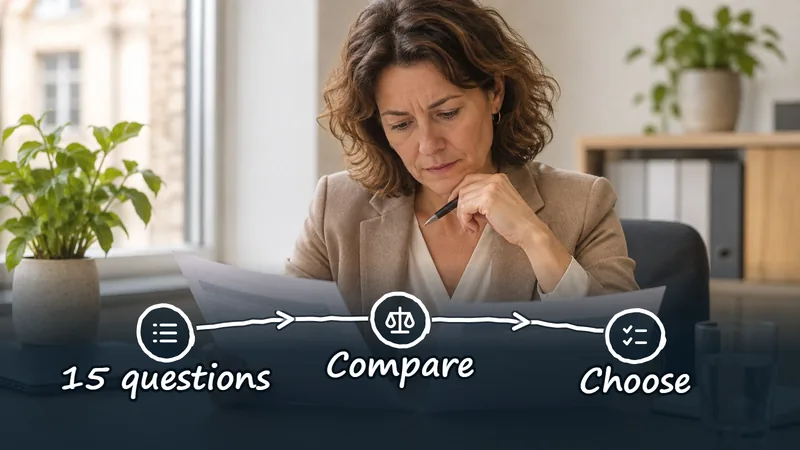
A procurement checklist for sovereign software tests sovereignty with a fixed list of questions: legal seat, hosting layer, sub-processors, AI models, export and exit. This checklist of fifteen questions can be used in a supplier call or as an annex to an RFI.
Legal position
- What is the legal seat of the supplier and of its parent company?
- Does the supplier or a sub-processor fall under non-European law such as the CLOUD Act?
- On what basis is personal data transferred outside the EU, see Schrems II?
Hosting and sub-processors
- Which infrastructure supplier belongs to the service and where does it run?
- Which sub-processors are there, and is there a current list?
- Is a move or change planned and how is it communicated?
AI
- Which AI models are used and who runs them?
- Can the organisation choose the model, also an EU-hosted or local model, see European AI models?
- Is training done on our data?
- How is AI-generated content marked, see marking?
Security and access
- Which standards are followed (for example ISO 27001), and how is that demonstrable?
- How do I set access per team or project?
Export and exit
- In which formats can I export everything, including metadata and permissions?
- What are the notice period and switching costs, see Data Act?
- What happens to my data after termination, and within what period?
How to weigh the answers
An honest answer with a "not yet" is worth more than a vague "yes". Ask for evidence and record the answers. A checklist does not make a supplier sovereign or your organisation compliant: it helps you ask targeted questions. The responsibility for the assessment stays with you.
The questions answered for CoVince
As an example of how a supplier can answer, these are the answers of CoVince to the questions on hosting, AI and security. CoVince runs in Europe, with a European cloud provider and not a US hyperscaler (question 4). In the model picker an organisation chooses for itself which model the CrewMate uses: European models from Mistral AI (EU endpoint) and Scaleway (Europe), models from other providers or local models (questions 7 and 8). AI-generated audio and video get a marking in the file metadata (question 10). CoVince is ISO 27001 certified (question 11) and access is managed per organisation and journey (question 12). Ask for evidence yourself, from us too.
How to use the list in an RFI
Put the fifteen questions as open questions in the annex and ask suppliers to answer each with an explanation and a piece of evidence. Give no points for a flat "yes" without substantiation. A supplier that honestly answers "not yet, planned for Q3" gives you more information than a supplier that confirms everything.
A simple scoring method
- 2 points: demonstrable and current.
- 1 point: planned, with a date and a moment of proof.
- 0 points: unanswered or not demonstrable.
Weigh the questions by the sensitivity of your data. For personal data the first group (legal and hosting) weighs heavier, for continuity the last (export and exit).
An example: a regional environmental agency
Imagine a fictional environmental agency with 120 staff comparing three collaboration platforms. The procurement officer weighs the groups: legal and hosting count double, because permit files with personal data go in, and export and exit also count double, because the contract runs five years. Supplier A scores 2 points on almost everything, but cannot show a current list of sub-processors for question 5. Supplier B scores lower on AI, but gives an honest "not yet, planned for Q3" with a date. Supplier C answers "yes" everywhere without evidence and gets 0 points for those questions. The agency records the scores and the explanation, asks A for the list and invites A and B for a demo. The outcome is not "the winner is the most European", but a substantiated assessment that the board can follow.
Red flags in an answer
- An answer that does not answer the question, such as "we take security very seriously".
- "Data in the EU" without saying anything about the legal seat or sub-processors.
- Export only "on request", without formats or period.
- No clear notice period or switching costs.
- A certificate without saying what the scope is.
Common mistakes
The first mistake is using the checklist only after the choice, to justify it afterwards. The second is weighing all questions equally, while a municipality with special categories of personal data has other priorities than a design agency. The third is not naming an owner for keeping the answers up to date: after a year they are outdated. So plan an annual repeat of the most important questions, and ask the supplier to report by itself when an answer changes, for example with a new sub-processor or a new hosting partner.
What you do on Monday
- Pick the software package that holds the most sensitive data and start there.
- Ask the fifteen questions to the current supplier, not only to the new one.
- Decide the weighting per group and write it down before the answers come in.
- Record the answers and the assessment and plan the repeat.
Frequently asked questions
What do I use this checklist for?
For a supplier call, an RFI or an internal assessment of software.
Which question matters most?
It depends on your data. For personal data: legal seat, hosting and sub-processors. For continuity: export and exit.
How do I weigh a "not yet"?
Honesty is a good sign. Check whether there is a concrete plan and a moment of proof.
Is this a legal test?
No, it is general information. Have the outcome checked by your lawyer or procurement officer.
Do I have to ask all fifteen questions?
No. Start with the groups that fit your data and add the rest if the first answers give reason to.
Can I use the checklist for a European supplier too?
Yes. A European seat does not answer all questions: sub-processors, export and exit remain relevant.