
Schrems II and the GDPR
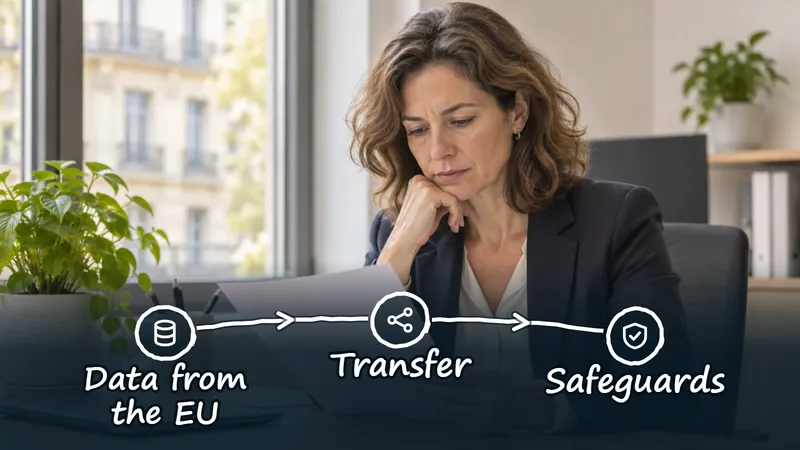
In the Schrems II ruling of July 2020 the Court of Justice of the EU invalidated the Privacy Shield. Transferring personal data to the US became an assessment that organisations must make themselves, per supplier, and be able to justify.
The ruling in brief
Max Schrems, an Austrian privacy activist, complained about Facebook transferring his data to the US. In 2020 the Court held that the Privacy Shield offered insufficient protection because of US intelligence access. Earlier, in 2015 (Schrems I), its predecessor Safe Harbor had already fallen.
What remained
Standard contractual clauses (SCCs) remained valid, but the Court required the exporter to assess case by case whether the receiving country offers equivalent protection in practice, and to take extra measures where needed. In 2023 the European Commission adopted a new adequacy decision, the EU-US Data Privacy Framework. It is in effect, but is being challenged in court, and critics expect a court to look at it again.
What this means for you in practice
- You remain responsible as controller, even when you pick a large supplier.
- You must be able to show you assessed the transfer (a transfer impact assessment).
- A supplier under US jurisdiction remains a point of attention, see the CLOUD Act.
- A European alternative makes that assessment simpler, because there is less transfer.
A short checklist
- Where is personal data processed, including by sub-processors?
- On what basis is it transferred (adequacy decision, SCCs)?
- What additional measures exist (encryption, pseudonymisation)?
- What is your plan if the framework is struck down again? See your exit strategy.
This article is general information, not legal advice. Put specific questions to your data protection officer or lawyer.
A timeline to remember it
- 2015: Schrems I. The Court strikes down Safe Harbor.
- 2016: the Privacy Shield arrives as successor.
- 16 July 2020: Schrems II. The Privacy Shield is invalid, SCCs remain under conditions.
- 2021: the Commission publishes new standard contractual clauses.
- 2023: the EU-US Data Privacy Framework is adopted as a new adequacy decision.
The pattern is always the same: a framework is adopted, challenged and sometimes struck down. An organisation that bases its choices on one framework faces the same question after every ruling. That is why it pays to have a plan B.
A transfer impact assessment in four steps
- Describe the transfer: which data, to whom, for what purpose, with which sub-processors.
- Determine the instrument: adequacy decision, standard contractual clauses or another basis.
- Assess the practice in the receiving country: can authorities reach the data, and what remedies exist?
- Choose additional measures and record why they suffice, or that you end the transfer.
An example: the regional logistics company
A logistics company with six hundred employees uses a US HR system for rosters, absence and appraisals. That is personal data of employees, partly special category. The transfer rests on the Data Privacy Framework, with SCCs as a fallback. The data protection officer describes the data, establishes which data is really needed and leaves absence details out of the export to the US. They also record what a switch to another system would cost if the framework is withdrawn. That produces a document a supervisor can read, and a decision the management stands behind.
The role of the data protection officer
Your DPO can guide and review the assessment. Involve them before procurement, not after. A fixed list of questions, such as the procurement checklist, makes the assessment repeatable for the next tools.
Which bases exist?
Chapter V of the GDPR (articles 44 to 49) has an order. First an adequacy decision (article 45): the Commission establishes that a country or framework offers sufficient protection. Without a decision there are appropriate safeguards (article 46), such as standard contractual clauses or binding corporate rules within a group. Only when both are missing can the derogations of article 49 play a role, and those are meant for incidental situations, not for a collaboration tool used every day. Whoever knows this distinction quickly sees where the vulnerable spot in a supplier relationship is.
Common mistakes
- Thinking a certification of the supplier replaces your own assessment.
- Forgetting the supplier's sub-processors, while data goes there too.
- Overlooking remote support and administration: access from a third country also counts as a transfer.
- Doing the assessment once and never revisiting it.
What you can do on Monday
Ask your DPO which transfers to the US exist now and whether each has a documented assessment. Start with the tool holding the most personal data. Check in the contract which basis was chosen, and note what you do if it lapses. That turns an abstract ruling into a concrete list.
Where CoVince fits
CoVince runs in production in Europe, with a European cloud provider, and is ISO 27001 certified. That limits transfers to third countries for the hosting layer, but a platform does not make you GDPR compliant by itself: you remain responsible for your processing and your assessment.
Frequently asked questions
Is transferring data to the US now forbidden?
No. It is possible, based on the Data Privacy Framework or standard contractual clauses, provided you assess it and take extra measures where needed.
What is the Data Privacy Framework?
A 2023 adequacy decision of the European Commission for transfers to certified US companies. It is being challenged in court.
Who is responsible for the assessment?
The organisation that processes the personal data, so you, not the supplier.
Does a European alternative help?
Yes, because there is less transfer to third countries and the assessment becomes simpler. Also check the hosting layer and sub-processors.
Does remote access count as a transfer?
Yes. Even when an employee of the supplier can reach personal data from a third country, that can be a transfer.
When do I revisit my assessment?
After a new ruling or decision, when sub-processors or the data you share change, and at least periodically.