
Data residency is not sovereignty
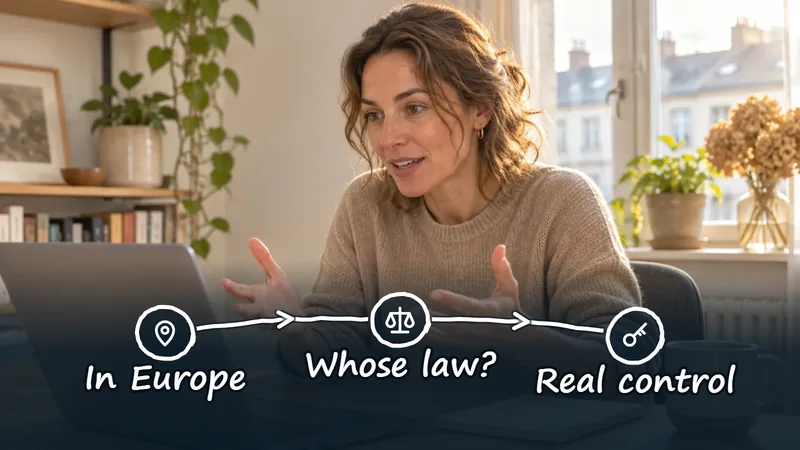
Data residency says where your data physically sits. Digital sovereignty is about who can legally reach it and what you can do with it. Data in an EU region of a US provider meets the first, but says nothing about the second.
Two different questions
| Data residency | Digital sovereignty |
|---|---|
| Where does my data physically sit? | Who can legally reach it, and under which law? |
| A matter of region and data centre | A matter of seat, control and dependency |
| Often selectable in a setting | Follows from the structure of the supplier |
Why an EU region is not enough
A provider that falls under US jurisdiction can be required under the CLOUD Act to hand over data it controls, even when that data sits in Europe. The region does not change who the provider is. The hosting layer counts too: a European software supplier that runs on the cloud of a US provider has that layer in its chain.
Good questions to ask
- What is the legal seat of the supplier and of its infrastructure provider?
- Which sub-processors have access to the data and where are they?
- Where does the AI that works with your data run? See European AI models.
- Can you leave? See exit strategy.
Honest about ourselves
That applies to us too. CoVince runs in production in Europe, with a European cloud provider with no US hyperscaler, and is ISO 27001 certified. That is an answer to the first two questions above, but it remains your assessment: a platform does not make an organisation compliant by itself, and you choose AI models yourself in the model picker.
Watch the marketing language
Sentences such as "your data stays in Europe" are true or false at the level of the storage location, and say nothing about who controls the data. Ask further: who manages the keys, which employees have access and from which country, and which sub-processors are involved?
Seven layers where control sits
- Seat: which law do the supplier and its parent company fall under?
- Infrastructure: who supplies the servers and network the service runs on?
- Administration: who has administrative rights, and from which country?
- Keys: who manages the encryption keys?
- Support: can a support employee outside the EU reach your data?
- Sub-processors: who else processes, and is a change notified?
- AI: which model processes your documents, and where does it run?
Data residency touches only the second layer, and even then partly. The other layers decide whether you have control.
An example: the regional energy company
A regional energy company selects a software package for customer communication. The salesperson stresses that all data sits in a data centre in the Netherlands. The buyer asks three follow-up questions and gets the answers in writing: the infrastructure is supplied by a US hyperscaler, support from three countries has administrative rights and the supplier manages the keys. The energy company decides to use the package for general communication but not for customer files with payment details, and asks for a timeline for key management under its own control. That is an assessment the company can explain, which is exactly the point.
What a "sovereign cloud" does and does not say
More and more offers appear under names such as "sovereign cloud" or "European region with extra safeguards". Judge them like any other claim: with the seven layers above. An extra management layer, a local joint venture or stricter access procedures can be real improvements, but the question remains under which law the party falls that ultimately has control. A label is not an answer; the contract and the described structure are.
A trade-off matrix per kind of data
Not every kind of data asks for the same. Public information can sit on a service you know little about. Ordinary business data asks for a written assessment of the seven layers. Personal, medical and governmental data ask for the strictest combination: European seat, European infrastructure, keys under your own control where possible and a tested exit. Write down per kind of data which requirement applies, so that not every purchase becomes a new discussion.
What does help
- A supplier with a European legal seat and a European infrastructure provider.
- Encryption with keys you manage, where possible.
- A contract that names sub-processors and changes to them.
Even then it remains a trade-off: nobody can exclude everything in the world. The goal is that you can explain your choice.
Common mistakes
- Treating an EU region as proof of European control.
- Not asking about the infrastructure provider because the software supplier is itself European.
- Treating marketing sentences as contractual commitments, while they are not in the agreement.
- Asking once, and not again when the infrastructure provider or sub-processors change.
What you can do on Monday
Pick the tool with the most sensitive data and ask your supplier in writing for an answer on the seven layers above. Lay the answers next to the working definition of digital sovereignty. You will quickly see which layer you cannot fill in. That is the place to start, for example with a question about key management or sub-processors.
Frequently asked questions
What is data residency?
The physical location (region, country) where your data is stored and processed.
Why is data residency not enough?
Because it does not say which law the provider falls under and who can legally reach the data.
Does the hosting layer count?
Yes. The infrastructure provider of your supplier is also a link in the chain.
Is an EU region useless, then?
No, it helps with latency and certain rules. It is just not the same as legal control.
Where does CoVince run?
In production in Europe, with a European cloud provider. CoVince is ISO 27001 certified; your own assessment remains necessary.
What do I ask a supplier first?
Its legal seat, its infrastructure provider, who has administrative rights and keys, and which sub-processors take part.