
What is digital sovereignty?
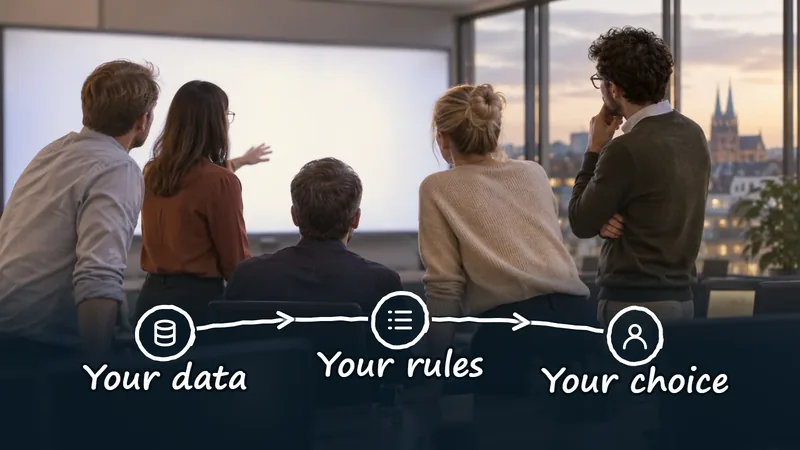
Digital sovereignty is an organisation's ability to decide where its data lives, who can legally reach it, which software and AI models work with it, and how it can leave a supplier again. It is about control, not only about where a data centre stands.
A working definition
The term is used widely and often loosely. For an organisation that collaborates in digital tools every day, a useful definition is that you keep control over four things: your data, the legal access to that data, the AI that works with it, and your freedom to leave.
- Data: you know which data sits where and who manages it.
- Legal access: you know which laws your supplier falls under and which authorities can compel what it holds.
- AI: you know which model processes your questions and documents, and you can choose it.
- Exit: you can take your data with you and switch without your organisation grinding to a halt.
Note the word "control". It is not a label on a product but a condition of your organisation: you can explain what you use, why, and what you do when it changes. Two organisations with exactly the same software can differ here, because one has its agreements, exports and alternatives in order and the other does not.
Why it matters now
Three developments meet. First, the CLOUD Act and the rulings around Schrems II, which show that the location of data is not the whole story. Second, new European rules such as NIS2 and the AI Act, which place responsibility for your supply chain and your AI with you. Third, the practice that collaboration, documents and AI converge at a handful of suppliers.
What it is not
Sovereignty is not a synonym for "build everything yourself", nor for "never use anything from the US again". It is a trade-off per application. For a public brochure it matters little where the tool comes from. For patient data, board papers or a municipality's data it does.
Data residency is not the same as sovereignty either. That data sits in a European data centre says nothing about who can legally reach it.
Where to start
- List the tools you collaborate in: chat, video, documents, boards, AI.
- Note for each tool the supplier, its legal seat and where the data is processed.
- Mark which data is sensitive. Start with those tools.
- Decide per tool whether a European alternative exists and what an exit would cost. See also the procurement checklist.
A first step can be small: one team, one project, one alternative to try. CoVince combines chat, video calls, own editors, boards and an AI CrewMate in one platform for that. Production runs in Europe, with a European cloud provider, and CoVince is ISO 27001 certified. Organisations remain responsible for their own choices; a platform does not make you compliant by itself.
An example from practice
Suppose a municipality uses one US platform for chat, documents and video across the whole organisation. Everything works nicely. Then the price changes, or a supplier adjusts its terms, or a court in another country asks for data. At that moment the municipality has no alternative ready, no tested export and no view of which data sits where. That is not a technical failure, it is a lack of control.
A second example: a regional housing association with three hundred employees. Tenant files sit in one system, meeting papers in another and chat in a third. Nobody has the full picture. Only when the association makes an inventory does it turn out that a small number of tools hold the most sensitive data. It starts there, and the rest waits.
Four questions to ask
- Within a reasonable time, can we set up everything we need somewhere else?
- Do we know which authorities can compel our supplier to hand over data?
- Can we show a supervisor that we weighed this?
- Do we decide which AI model reads our documents?
If you cannot answer all of these with "yes", that is no reason to panic. It is a list to work on, in order of the sensitivity of your data.
Common mistakes
- Treating sovereignty as an IT project, while the board must carry the trade-off.
- Looking only at where the data sits and forgetting the legal seat and the AI.
- Wanting to replace everything at once and finishing nothing.
- Never testing an exit, so that "we can leave" stays an assumption.
What you can do on Monday
Plan an hour with IT, procurement and your data protection officer. Write on one page the five tools that hold your most sensitive data, with supplier and legal seat. Pick one and ask your supplier for its list of sub-processors and export formats. Nothing more is needed this week; the result is a first map on which you can base your next choices.
Frequently asked questions
What is the difference between digital sovereignty and data residency?
Data residency says where your data physically sits. Sovereignty goes further: who can legally reach it, which AI works with it and whether you can leave.
Do I have to replace all US tools?
No. It is a trade-off per application and per kind of data. Start with the tools that hold sensitive data.
Is digital sovereignty a legal requirement?
No law carries that name. NIS2, the GDPR and the AI Act do impose duties that are hard to meet without insight into your suppliers.
Is a European product always sovereign?
Not automatically. Also look at where it runs, who supplies the infrastructure and which AI sits behind it.
Who in the organisation is responsible for this?
Ultimately the board, with IT, procurement and the data protection officer carrying it out. It is not a purely technical choice.
How long does a first step take?
An inventory of your most important tools and suppliers usually takes a few hours to a few days. After that you can weigh each tool.