
A European alternative to Miro
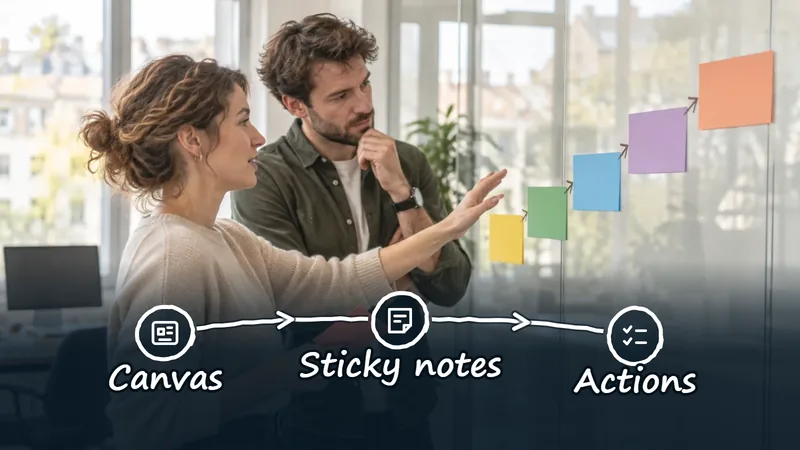
You look for a European alternative to Miro usually when a whiteboard has to be more than a sheet to draw on. CoVince has a canvas for sticky notes, timelines and action lists, and next to it the Control Room with live KPIs. The canvas belongs to a journey, so your board, chat and documents sit together, in a European platform.
A whiteboard that belongs to the work
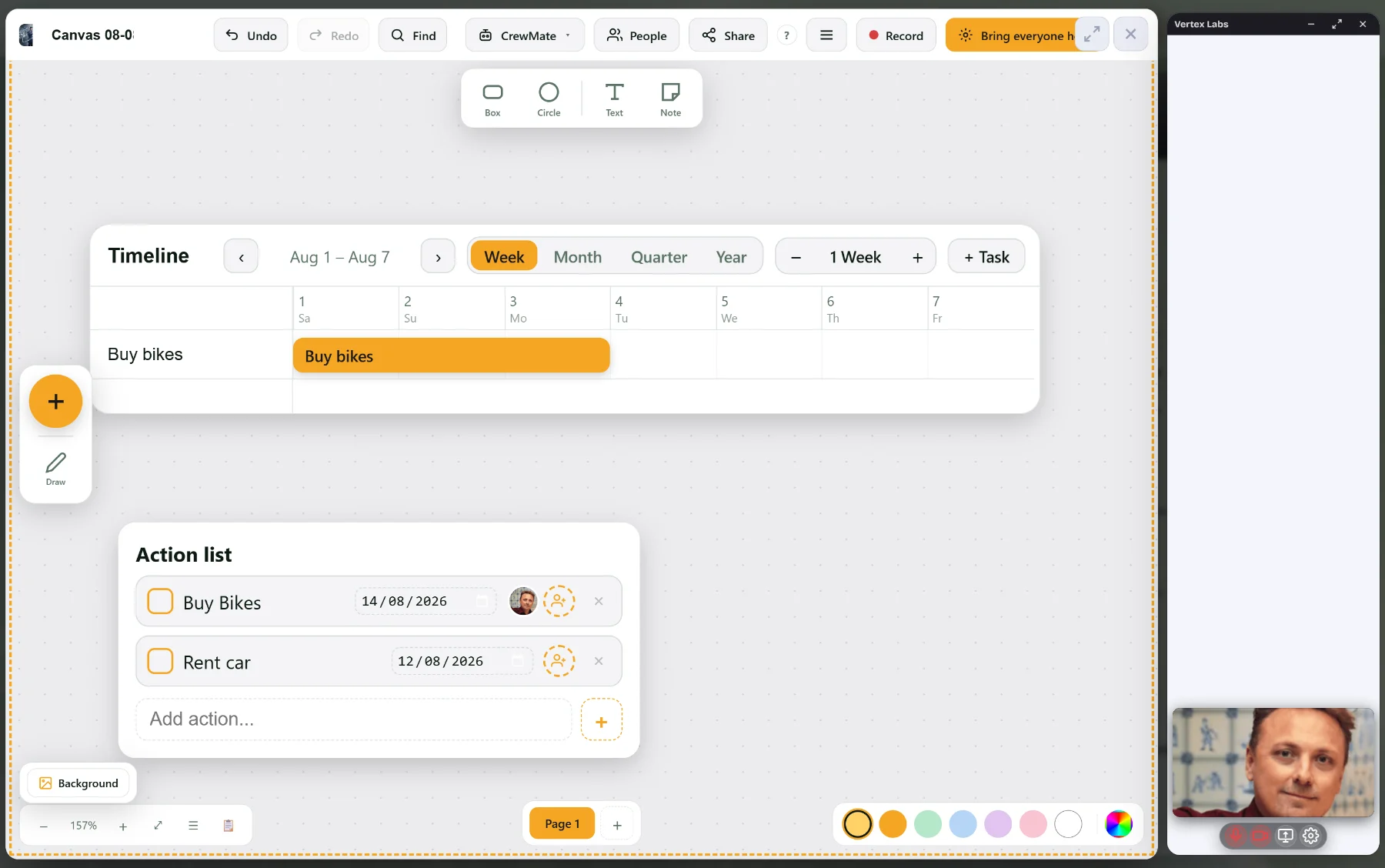
A standalone whiteboard is pleasant for a workshop but later loses its link with the work. The photo of the board ends up in a folder, the sticky notes never become actions. In CoVince the canvas is part of the journey: actions have an owner and a date, the timeline shows what must happen when, and the chat and documents sit alongside.
What you can do
- Sticky notes per step around a goal, as in a brainstorm or retrospective.
- A board with a timeline and an action list.
- The Control Room: live walls with KPIs and trends, see the page about the digital Obeya.
- A CrewMate that can think along on the board and fill cards.
Honest about the limits
CoVince is not a one-to-one copy of Miro. If you use Miro for very large, freely designed workshop boards with many templates and plug-ins, first check whether the canvas fits. We do not promise automatic import of Miro boards.
Why European
Boards often hold strategy, customer information and HR matters. A European platform makes the assessment under the GDPR simpler. CoVince runs in Europe, with a European cloud provider, and is ISO 27001 certified. It remains up to your organisation to decide who may access which board; you manage that access per organisation and journey. See the main page for the full status.
A workshop in five steps
- Put the goal at the top of the canvas.
- Let everyone add sticky notes, first individually and then together.
- Group the sticky notes and name the clusters.
- Pick the three most important and turn them into actions with owner and date.
- Link the board to the journey, so the follow-up stays visible.
An example: a quarterly workshop at a regional haulier
Suppose a haulage company with eighty employees holds a workshop every quarter with planners, driver coordinators and management on what can be improved in trip planning. Until now that happened on a large online whiteboard with hundreds of sticky notes, and afterwards a photo and a list of "good ideas" remained. Three months later nobody knew what had been carried out.
This quarter the planning manager uses a CoVince canvas in the journey "Trip planning". The goal is at the top: reduce waiting time at loading. Everyone adds sticky notes individually, the group clusters them into four themes and picks three. Those become actions with an owner and a date on the timeline. Because the board sits in the journey, the director sees in the weekly stand-up which actions are open, and the planners discuss them in the same chat. The next workshop does not start with a blank sheet, but with last quarter's board.
Which formats work
- Retrospective: what went well, what can be better, which actions? Always end with owners.
- Brainstorm: first silent and individual, then cluster, then vote.
- Roadmap: actions on a timeline, so dependencies are visible.
- Weekly stand-up: the Control Room with KPIs as a fixed wall, as with an Obeya.
Common mistakes
The biggest mistake is a workshop without follow-up: lovely sticky notes, no action. A second mistake is a board that grows too large to oversee; work with one board per theme instead. A third is that an external board in a standalone tool holds the only copy of a decision, while the journey should be the place where everyone finds it later. A fourth is forgetting the participants who join remotely: agree beforehand whether you call from the journey.
From workshop to weekly rhythm
A board only stays useful if it becomes part of a rhythm. A workshop is a peak; a good board is a weekly habit. So put a fixed, short stand-up for the journey in the calendar and then walk only through the actions that are red or late. Use the Control Room if you also want to follow numbers: KPIs then stand as a live wall next to the actions, and nobody has to build a presentation. That makes the difference between a board that is used once and a board the team looks at every week.
Access and external participants
For a workshop with a customer or a supplier you invite the external participants to the workshop's journey. They only see what belongs to that journey, not the rest of your organisation. Afterwards you withdraw the access or let it run, depending on whether the conversation continues. Agree beforehand what information may go on the board: a board with customer data needs the same care as a document.
How to start
- Put your next workshop or retrospective in a CoVince canvas.
- Turn it into an action list with owners.
- Link the board to the project's journey.
Also read how to use documents and grids in the same journey, and what the choice for a platform or separate tools means. A trial with the whole team can follow afterwards.
Frequently asked questions
Is there a European alternative to Miro?
CoVince has a canvas with sticky notes, timeline and actions and a Control Room, in a European platform.
Can I import Miro boards?
We do not promise automatic import. We discuss in a demo what is possible.
What is the advantage over a standalone whiteboard?
The canvas belongs to a journey with chat, documents and actions, so the board does not drift away from the work.
Does AI work on the board?
Yes, the CrewMate can think along and fill cards. You choose which model runs behind it.
Where does CoVince run?
In Europe, with a European cloud provider. CoVince is ISO 27001 certified.
Is the canvas suitable for a workshop with outsiders?
Yes, you invite external participants to the workshop journey. They only see what belongs to that journey.