
A European alternative to Microsoft Copilot
You look for a European alternative to Microsoft Copilot when you want to use AI in your work without the choice of model being outside your influence. CoVince's CrewMate is an AI colleague that thinks along in your journeys, boards and documents, and whose model an organisation admin chooses, including an EU-hosted model from Mistral AI or Scaleway, or a local model.
What an AI assistant in your work environment does
Summarising, making plans, writing text and answering questions based on your own data. The value is in the context: an assistant that knows your board and documents is more useful than a standalone chatbot. At the same time: every question contains something of your organisation. Whoever runs the model therefore partly decides what happens with that context.
CoVince's CrewMate
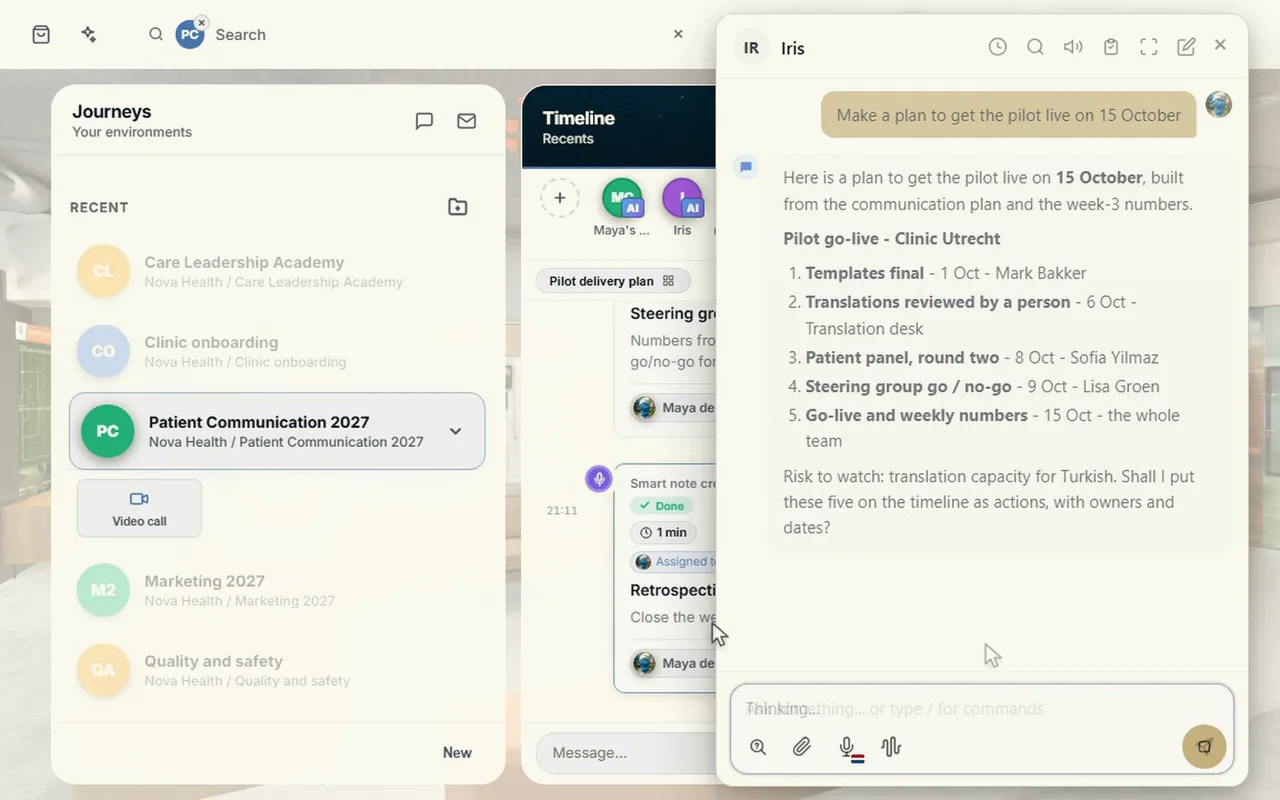
- Makes a plan with names and dates, for example to take a pilot live.
- Fills a board or a grid on request.
- Works in the context of the journey it sits in.
- Can speak with a 3D avatar. See the CrewMate page.
You choose the model
CoVince decides AI models in one place, in levels (top, standard, fast). An organisation admin can choose a model per level. You can choose EU-hosted models from Mistral AI (Europe) and Scaleway (Europe), a model on your own machine, or other supported models. So we do not say all AI runs in the EU: that is your choice, per level. Read more in European AI models and local AI models.
Honest about quality
A European model is not automatically as strong as the best model from a US provider; that depends on the task. Choose per task, test with real examples from your own work and record the choice. CoVince itself runs in Europe, with a European cloud provider, and is ISO 27001 certified; that says something about the platform, not about the outcome of a model.
Why AI matters for sovereignty
Every question to an AI model contains context from your organisation. Who runs the model, and where, is part of your assessment. See also AI Act article 50: AI-generated audio and video get a marking in the file's metadata in CoVince, with no visible label in the picture.
An example: the Policy department of a municipality
Suppose the Policy department of a mid-sized municipality, twenty employees, who write council proposals, minutes and memos. Every week time is lost on summarising, writing a first version and looking up earlier decisions. The department wants to use AI, but the civil servants who work with residents' data are rightly careful.
The department sets up a journey for "Environment vision" and lets the CrewMate help there: a first draft of a summary, a list of open questions, a schedule with names and dates. For standard work the admin picks an EU-hosted model; for writing a first text a model at the "standard" level. The files with personal data stay in a separate journey, where the department agrees that the CrewMate is not used. After two months the team compares the drafts with its own work: the summaries are usable, the legal texts the lawyers write themselves.
Checklist for AI use
- Which tasks suit AI: summarising, draft, planning? Which do not?
- Which level (top, standard, fast) belongs to which kind of work, and which model is linked to it?
- Which journeys contain sensitive data and are not meant for AI?
- Who checks the result before it leaves the organisation?
- How do you record the choice, so you can show it in an audit?
Common mistakes
The first mistake is choosing the model by name and not by task: a European model can be fine for your task, or not, and you only know after a test. The second is forwarding AI output without checking. The third is forgetting which data is in the question: a summary of a personnel file is still a processing of personal data. The fourth is appointing no owner for the policy, so everybody makes their own rules.
Record it
Write down which level applies to which kind of work and who may change it. That is usable in an audit and for colleagues' questions. More on criteria is in European AI models for your organisation, and on working without external processing in local AI models.
What AI does not decide for you
An AI colleague delivers a proposal, not a decision. A plan from the CrewMate is a first version that a person reviews, a filled grid is a starting point that someone checks. So keep final responsibility with a named person and record who that is. That holds regardless of the model you choose, European, local or otherwise: the model determines the quality of the proposal, not who is responsible for it.
What you do on Monday
Pick three tasks you want to try AI for, test them with one European and one other model, and compare the outcome with what your team writes itself. That way you decide on experience, not on reputation. Also read about an alternative to Teams if AI is part of a bigger switch.
Frequently asked questions
Is there a European alternative to Microsoft Copilot?
CoVince's CrewMate is an AI colleague in your journeys, boards and documents, with a model you choose yourself, also EU-hosted.
Which European models can I choose?
EU-hosted models from Mistral AI and Scaleway, plus local models on your own machine. An organisation admin chooses per level.
Does all AI run in the EU?
No, we do not claim that. You can choose European or local models; which model you use per level is decided by the organisation.
Are European models equally good?
That depends on the task. Test per application with your own examples.
Is AI-generated content marked?
Yes, AI-generated audio and video get a marking in the file metadata, with no visible label.
How do I limit what AI may see?
AI works in the context of the journey. You manage access per organisation and journey, and agree which journeys are not meant for AI.